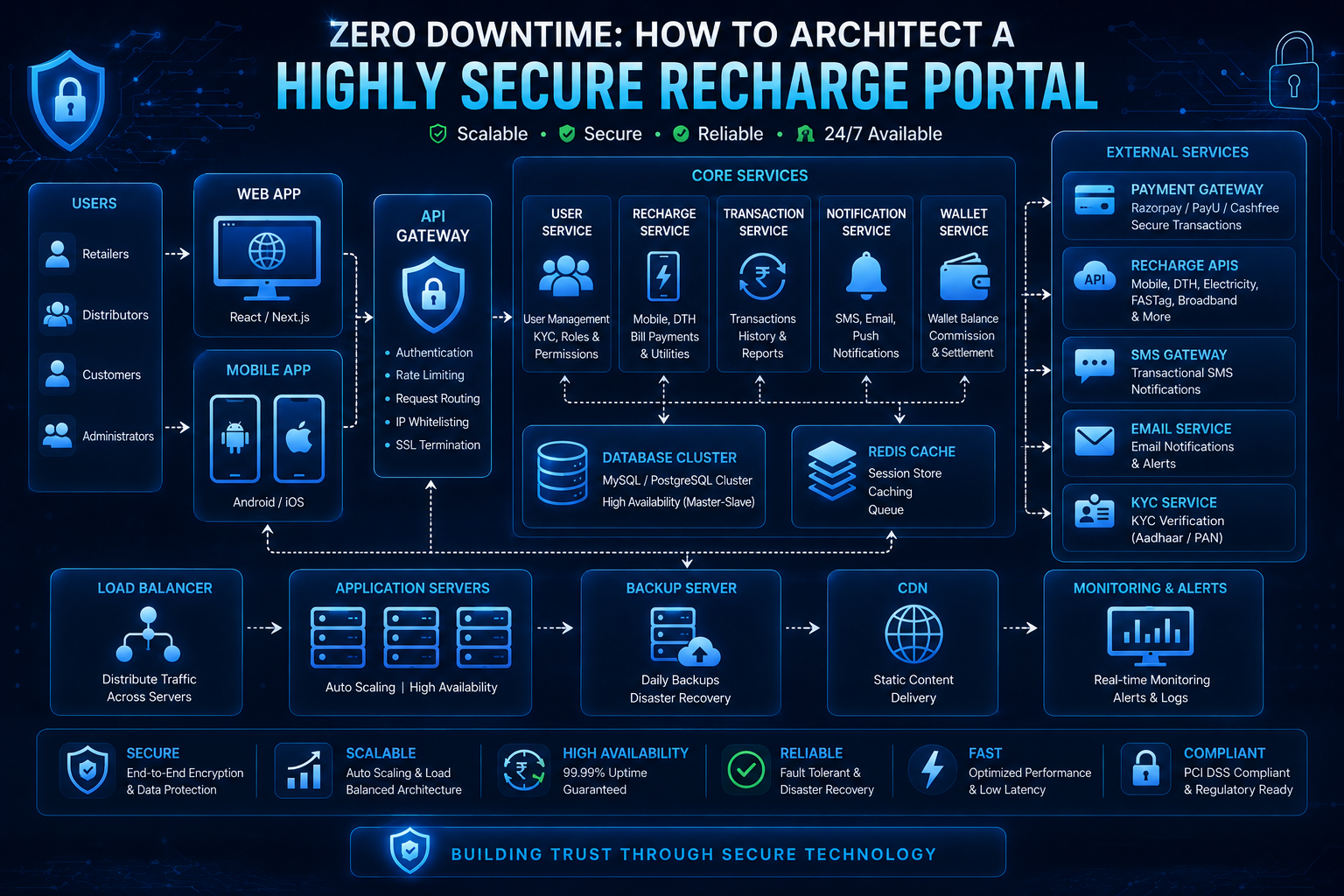
Zero Downtime: How to Architect a Highly Secure Recharge Portal Development Project
In today's digital business environment, users expect online services to work 24/7 without interruption. This is especially important for recharge platforms where customers expect mobile recharge, DTH recharge, utility payments, and other transactions to be processed quickly.
Even a few minutes of downtime can result in failed transactions, frustrated customers, support requests, and loss of business.
This is why Secure Recharge Portal Development should focus not only on features and design but also on architecture, security, scalability, monitoring, and recovery.
A professionally developed recharge portal should be capable of handling increasing traffic while keeping the system stable and secure.
At HNB IT Solutions, we focus on building software and digital platforms that combine performance, security, scalability, and user-friendly experiences for modern businesses.
What Is Recharge Portal Development?
Recharge portal development is the process of creating a web-based or mobile-based platform through which users, agents, retailers, or businesses can perform recharge and payment-related operations.
Depending on the business model, a recharge portal may include:
- Mobile recharge
- DTH recharge
- Electricity bill payment
- Broadband recharge
- Utility bill payments
- Wallet management
- User and agent accounts
- Transaction history
- Recharge API integration
- Payment gateway integration
- Admin dashboard
- Commission management
- Reports and analytics
- Notifications
- Secure authentication
The exact features depend on the requirements of the business.
The important thing is that the portal should be designed in a way that one failed component does not bring down the entire system.
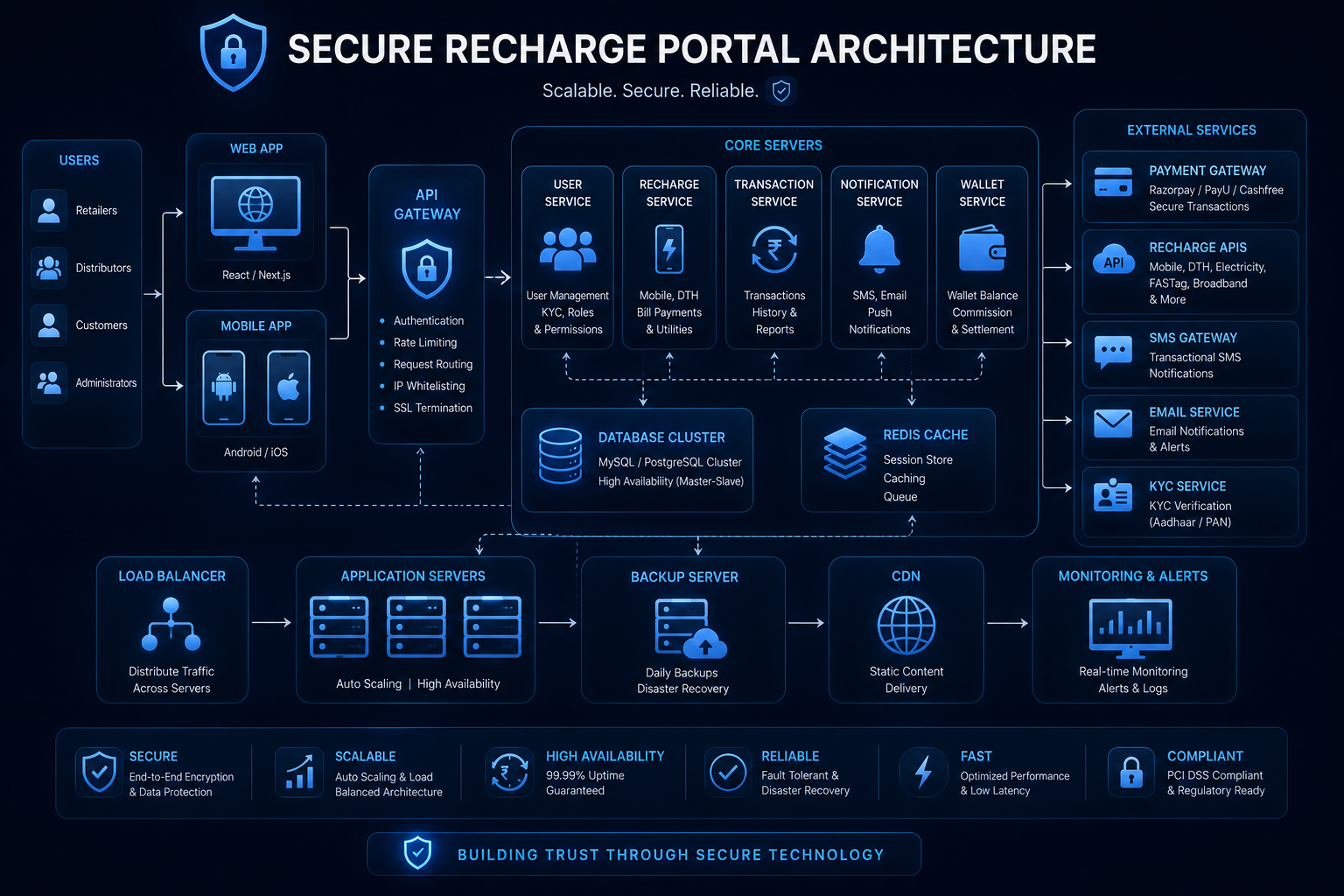
Why Zero Downtime Matters for a Recharge Portal
Imagine a customer opens your recharge portal and tries to complete a transaction, but the website is unavailable.
They may:
- Leave the website.
- Try another platform.
- Contact customer support.
- Lose confidence in your service.
For a recharge business handling thousands of transactions, repeated downtime can become a serious operational problem.
Zero downtime architecture aims to keep a system available even when individual servers, services, or components experience problems.
Technically, absolute zero downtime can be difficult to guarantee. However, a well-designed architecture can achieve very high availability by eliminating single points of failure and providing automatic recovery mechanisms.
Key Components of a Secure Recharge Portal Architecture
A secure recharge portal should be built using multiple layers rather than depending on a single server or application.
Let's look at the important components.
1. Load Balancing
A load balancer distributes incoming requests across multiple application servers.
For example, instead of:
Users → One Server
a scalable architecture can use:
Users → Load Balancer → Server 1 + Server 2 + Server 3
If one server becomes unavailable, traffic can be redirected to the healthy servers.
This helps improve:
- Availability
- Performance
- Scalability
- Fault tolerance
It also makes it easier to perform server maintenance without taking the entire portal offline.
2. Multiple Application Servers
A single-server setup can become a major risk as traffic increases.
If the server crashes, the complete application may become unavailable.
A better architecture uses multiple application instances.
This approach allows the platform to continue working even if one application server has an issue.
3. Database High Availability
The database is one of the most important parts of a recharge system.
It stores information such as:
- User accounts
- Wallet balances
- Recharge transactions
- Payment records
- API responses
- Commission data
- Agent information
- Transaction status
If the database fails, the entire transaction system can be affected.
Therefore, database architecture should include suitable replication, automated backups, monitoring, and disaster recovery mechanisms.
For larger systems, database replication can help maintain a secondary database that can take over when required.
4. Recharge API Redundancy
Recharge portals generally depend on external APIs to process recharge or utility transactions.
This creates another potential point of failure.
For example:
Customer → Recharge Portal → Recharge API → Operator
If the external API becomes slow or temporarily unavailable, the portal needs to handle that situation correctly.
A robust system can use:
- API health checks
- Timeout handling
- Retry mechanisms
- Queue-based processing
- Multiple API providers where commercially and technically appropriate
- Transaction status verification
- Failure logging
The goal isn't simply to send the request again and again.
The system needs to understand whether the original transaction was actually processed before attempting another transaction.
5. Idempotency: A Very Important Recharge Security Feature
One of the most overlooked parts of payment and recharge software is duplicate transaction prevention.
Consider this situation:
A customer clicks the recharge button.
The request reaches the API, but the response is delayed.
The customer thinks the transaction failed and clicks again.
Without proper transaction controls, the system could potentially process the same request twice.
An idempotency mechanism helps prevent this.
Each transaction can have a unique identifier, such as:
Transaction ID: RECH20260826123456
The backend checks whether the request has already been processed before creating another transaction.
This is extremely important for financial and recharge-related systems.
6. Secure Authentication and Authorization
Security starts with user access.
A recharge portal may have different users:
- Customers
- Retailers
- Agents
- Managers
- Sub-admins
- Super administrators
Each user should only have access to the features they are authorised to use.
A secure system can implement:
- Strong password policies
- Secure password hashing
- OTP verification where appropriate
- Role-based access control
- Session management
- Login monitoring
- Account lockout mechanisms
- Admin activity logs
For example, a retailer shouldn't have access to sensitive super-admin settings.
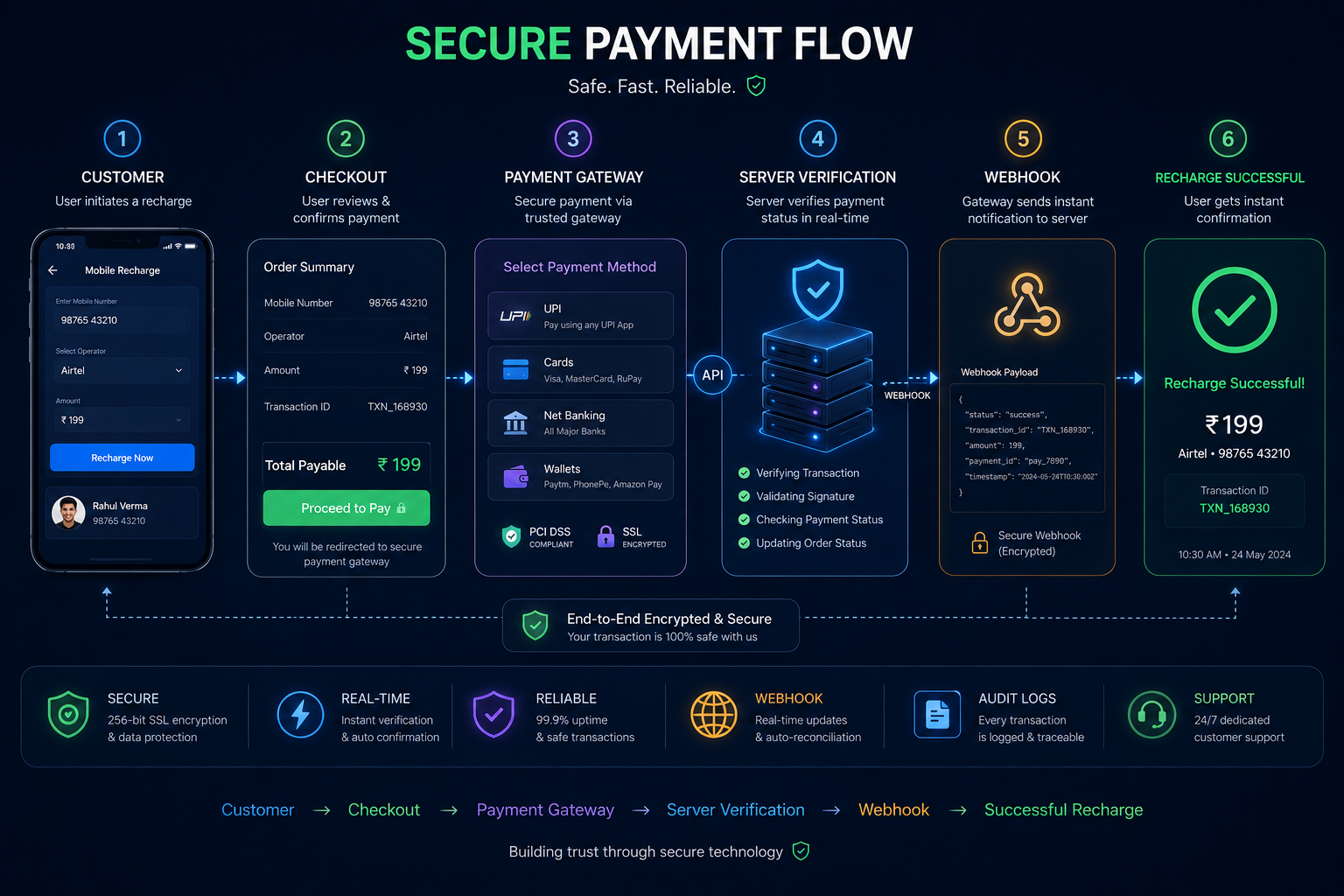
7. Protect the Recharge Portal APIs
APIs are often the backbone of a recharge platform.
However, publicly exposed APIs can become a target for abuse.
API security should include:
Authentication
Only authorized applications and users should be able to access protected endpoints.
Rate Limiting
Limit the number of requests from a particular user, IP, token, or application within a certain time period.
Input Validation
Never trust data coming from the frontend.
The backend should validate every important parameter.
API Logging
Maintain useful logs for:
- Request time
- Response time
- Status
- Transaction ID
- Error details
- API endpoint
Sensitive credentials and private information should not be unnecessarily stored in logs.
8. Payment Gateway Security
If the recharge portal accepts online payments, payment gateway integration should be designed carefully.
A secure payment flow generally looks like:
User → Secure Checkout → Payment Gateway → Payment Verification → Recharge System
The application should verify payment status from a trusted server-side source rather than simply trusting a frontend success message.
Webhook verification is also important where supported.
The system should validate:
- Transaction ID
- Payment status
- Amount
- Order ID
- Signature/hash
- Timestamp where applicable
This helps reduce fraudulent or manipulated payment notifications.
9. Use HTTPS Everywhere
A professional recharge portal should use HTTPS throughout the application.
HTTPS helps protect information transmitted between the user's device and the server.
It is particularly important when handling:
- Login credentials
- User information
- Payment-related data
- API requests
- Authentication tokens
An SSL/TLS certificate should be correctly configured and renewed before expiration.
10. Web Application Firewall
A Web Application Firewall, commonly called a WAF, can help protect a web application from various malicious requests.
Depending on the configuration, a WAF can help detect or block suspicious traffic associated with attacks such as:
- SQL injection
- Cross-site scripting
- Malicious bots
- Unusual request patterns
- Certain automated attacks
A WAF should be considered one layer of security rather than the complete security solution.
11. DDoS Protection
A recharge portal can also face unusually large volumes of traffic.
Distributed Denial-of-Service attacks attempt to overwhelm a service with traffic.
DDoS protection can help filter malicious traffic before it reaches the application infrastructure.
A good infrastructure strategy combines:
CDN + DDoS Protection + WAF + Load Balancer + Application Security
This layered approach is much stronger than relying on a single security mechanism.
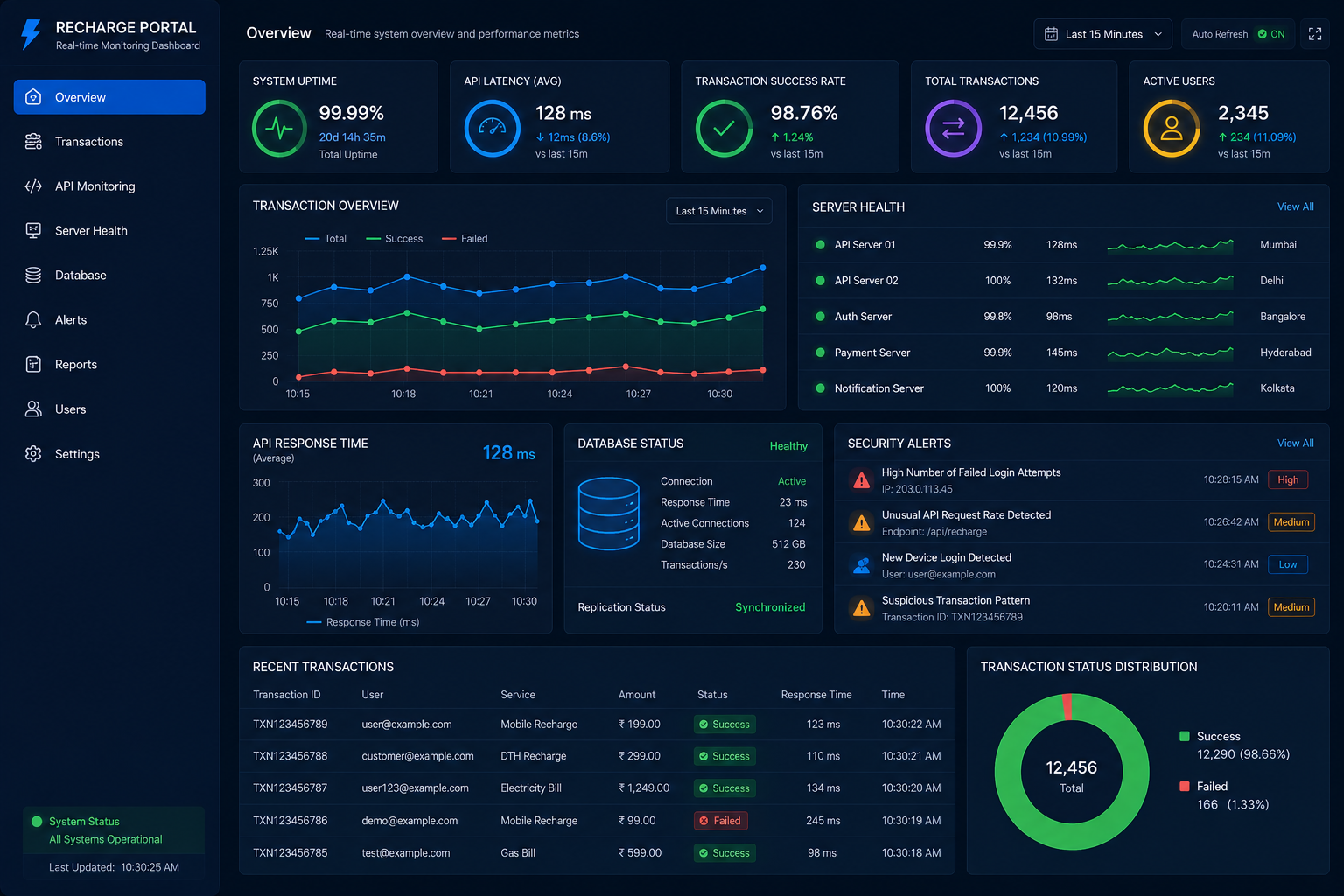
12. Monitoring and Real-Time Alerts
You can't protect what you don't monitor.
A professional recharge portal should continuously monitor important infrastructure and application metrics.
These may include:
- Server CPU usage
- Memory usage
- Disk usage
- API response time
- Database performance
- Failed transactions
- Login failures
- Server errors
- Payment failures
- Recharge API failures
If something unusual happens, administrators should receive an alert.
For example:
Recharge API response time increased → Alert generated → Technical team investigates.
This can help identify problems before they become major outages.
13. Automated Backup and Disaster Recovery
Even with strong infrastructure, unexpected problems can happen.
Hardware failures, software bugs, accidental deletion, security incidents, and infrastructure issues can affect applications.
This is why automated backups are essential.
A backup strategy can include:
- Regular database backups
- Encrypted backup storage
- Off-site backups
- Backup retention policies
- Automated backup verification
- Disaster recovery procedures
But remember:
A backup that has never been tested is not a reliable backup strategy.
Regular restoration testing should be performed to confirm that backups can actually be recovered when needed.
14. Caching for Better Performance
Caching can reduce unnecessary database and API requests.
Frequently requested data can be cached for a suitable period.
Examples include:
- Operator lists
- Recharge plans
- Static configuration
- Public information
- Frequently accessed dashboard data
However, sensitive transactional data such as wallet balances should be handled carefully.
Performance should never come at the cost of transaction accuracy.
15. Secure Admin Panel
The admin panel is one of the most sensitive parts of a recharge platform.
A compromised admin account can potentially cause serious damage.
A secure admin panel should consider:
- Two-factor authentication
- Role-based permissions
- Strong passwords
- IP restrictions where suitable
- Login activity
- Admin action logs
- Session timeout
- Suspicious login alerts
- Secure API access
Every important administrative action should ideally be traceable.
For example:
Admin → Changed commission → 26 Aug 2026 → 13:42 → Logged
This creates accountability and makes troubleshooting easier.
16. Regular Security Testing
Security is not something you configure once and forget.
A secure software development process should include regular reviews and testing.
Depending on the application, testing may include:
- Vulnerability scanning
- Dependency updates
- API security testing
- Authentication testing
- Access-control testing
- Code review
- Penetration testing
- Server configuration review
Third-party libraries and frameworks should also be kept updated where practical.
17. Scalable Infrastructure for Growing Businesses
A recharge portal may start with a few hundred users and eventually grow to thousands or millions of requests.
The architecture should therefore be designed with future growth in mind.
Instead of rebuilding the entire system later, businesses can plan for:
Horizontal Scaling
Add more application servers when traffic increases.
Vertical Scaling
Increase server resources when required.
Database Scaling
Use optimized queries, indexes, replication, caching, and suitable database architecture.
CDN
Deliver static resources efficiently from geographically distributed locations.
Zero Downtime Deployment Strategy
Software updates are another common reason websites experience downtime.
Instead of taking the complete application offline during every deployment, businesses can use strategies such as:
Blue-Green Deployment
Two production environments are maintained.
- Blue = current version
- Green = new version
After testing the new environment, traffic can be switched to it.
Rolling Deployment
The update is gradually deployed across multiple servers.
One server is updated while others continue serving users.
This reduces the risk of taking the entire platform offline during an update.
Security + Performance Should Work Together
One common mistake is focusing only on performance.
A very fast recharge portal is not useful if it has weak security.
Similarly, an extremely secure system that is slow and difficult to use can create a poor customer experience.
A good architecture balances:
Security + Performance + Availability + Scalability + User Experience
These five areas should be considered during the planning stage itself.
Recommended Architecture for a Secure Recharge Portal
A modern architecture could look something like this:
USERS ↓ CDN / DDoS Layer ↓ WAF ↓ Load Balancer / | \ ↓ ↓ ↓ App 1 App 2 App 3 \ | / API / Services ↓ Transaction Queue / \ ↓ ↓ Recharge APIs Payment APIs \ / ↓ ↓ Transaction Service ↓ Primary Database ↓ Replica / Backup ↓ Monitoring + Alerts
This architecture provides multiple layers of protection and helps reduce single points of failure.
How HNB IT Solutions Can Help
Building a reliable recharge portal requires more than just coding a website.
At HNB IT Solutions, we provide software development solutions for businesses looking to build secure and scalable digital platforms.
Our development services include:
- AI Tools Development
- Mobile App Development
- Web App Development
- Custom Software Development
- Payment Gateway Integration
- API Integration
- SMS & Bulk SMS Services
- Digital Marketing
- Software Consultancy
- Business Website Development
We can help businesses plan the complete technology stack, from application development and API integration to security, deployment, scalability, and ongoing improvements.
We also focus on developing SEO-friendly websites and business applications that are designed around the actual requirements of the business.
Why Choose a Professional Recharge Portal Development Company?
A professional development team can help you avoid many common technical problems before they become expensive.
A good development process should cover:
Requirement Planning → UI/UX → Architecture → Development → API Integration → Security Testing → Deployment → Monitoring → Maintenance
This structured approach can make the project more reliable and easier to scale.
The cheapest development solution isn't always the best option when your platform will handle important customer transactions.
Final Thoughts
A successful recharge platform needs much more than a simple recharge form and payment button.
Secure Recharge Portal Development should be planned around availability, security, transaction accuracy, API reliability, monitoring, backups, and scalability from day one.
Zero-downtime architecture doesn't mean that technical failures can never happen. Instead, it means designing the system so that one failure doesn't automatically bring down the entire platform.
With load balancing, redundant servers, secure APIs, database backups, monitoring, disaster recovery, payment verification, and scalable infrastructure, businesses can build a recharge portal that is ready for long-term growth.
If you're planning a secure recharge portal, custom web application, mobile app, or business software, HNB IT Solutions can help you plan and develop a solution based on your business requirements.
Frequently Asked Questions
1. What is Secure Recharge Portal Development?
Secure Recharge Portal Development is the process of building a recharge platform with security controls, protected APIs, secure authentication, reliable transaction processing, payment verification, monitoring, and backup systems.
2. What does zero downtime mean?
Zero downtime refers to an architecture designed to keep a service available even when individual servers, components, or services experience failures. In practice, businesses aim for very high availability rather than assuming that failures are impossible.
3. How can I make a recharge portal more secure?
Use HTTPS, secure authentication, role-based access, API authentication, rate limiting, input validation, payment verification, database backups, monitoring, WAF protection, and regular security testing.
4. Why is API security important for recharge software?
Recharge platforms often depend on APIs for transactions. If APIs are poorly secured, attackers may attempt unauthorized requests, abuse endpoints, or manipulate transaction flows. Proper authentication, validation, rate limiting, logging, and monitoring can reduce these risks.
5. Can a recharge portal handle high traffic?
Yes. A properly architected platform can scale using load balancing, multiple application servers, caching, optimized databases, queues, CDN infrastructure, and other suitable scaling techniques.
6. Is payment gateway integration possible in a recharge portal?
Yes. A recharge portal can integrate with a suitable payment service provider or gateway. Payment status should be verified securely on the server side before confirming a transaction.
7. Why are backups important for a recharge portal?
Backups help recover important application and transaction data after unexpected failures, accidental deletion, infrastructure problems, or other incidents. Backups should also be regularly tested.
8. How long does recharge portal development take?
The timeline depends on the number of features, UI/UX requirements, API integrations, admin functionality, security requirements, testing, and deployment architecture. A simple portal and an enterprise-level platform can have very different development timelines.