The Tech Stack Blueprint for a High-Concurrency Mobile Recharge App Development Project
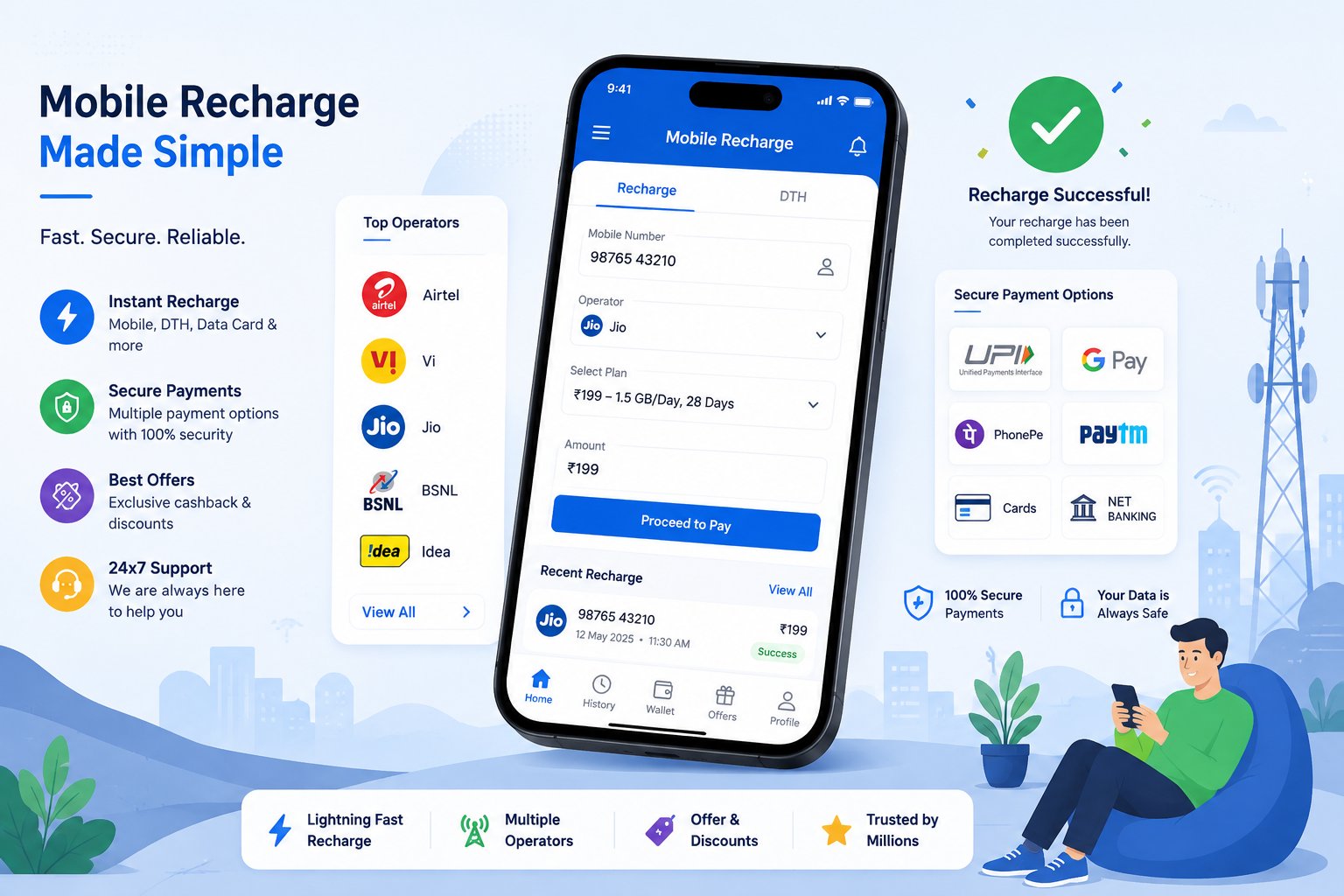
Mobile recharge apps look simple from the outside. You open the app, pick your operator, enter the number, pay, and boom — recharge done in 10 seconds. But if you have ever tried building one, you already know the truth: the "10 second experience" hides a genuinely complex system underneath, one that has to survive thousands (sometimes lakhs) of users hitting "Pay Now" at the exact same moment — usually right after a telecom operator announces a new plan or during festival offers.
At HNB IT Solutions, we've worked on multiple recharge and utility payment apps, and if there's one lesson we've learned the hard way, its this — a recharge app is not a "normal" app. It's a financial transaction system disguised as a simple utility app, and it needs to be engineered like one.
In this article, we're breaking down the actual tech stack blueprint you need for a high-concurrency mobile recharge app, the kind that doesn't crash during IPL sale offers or month-end recharge rush hours.
Why "High Concurrency" Actually Matters Here
Before jumping into tools and frameworks, let's understand the actual problem we're solving.
A recharge app usually has these concurrency spikes:
- Salary days (1st and last week of the month)
- Festival & cashback offer periods
- Telecom operators changing plans overnight
- Bill payment due dates (electricity, DTH, broadband)
During these windows, your app might get 50x-100x normal traffic in a span of minutes. If your backend isn't build for this, you'll see failed transactions, duplicate charges, and angry 1-star reviews within hours. And in the recharge business, trust is everything — one duplicate deduction and users uninstall permanently.
So the tech stack isn't just about "what languages to use," its about choosing tools that can handle burst traffic, queue transactions safely, and never lose money mid-way.
1. Frontend: Where Speed Meets Simplicity
For a recharge app, the frontend has to be lightweight and fast-loading, because users open it, complete task, and leave. No one is "browsing" a recharge app for fun.
Recommended stack:
- Flutter (for cross-platform Android + iOS from single codebase) — great for startups who want faster time-to-market
- Kotlin (Native Android) — if Android-only is priority and you need deeper hardware/OS level integrations
- React.js / Next.js — for the web version and admin-facing dashboards
Flutter especially works well here because recharge apps don't need heavy native animations — they need clean UI, fast form validation, and smooth navigation, all of which Flutter handles very well while saving development cost.
2. Backend: The Real Battlefield
This is where high-concurrency actually gets decided. Your backend architecture decides whether your app survives a traffic spike or falls flat.
Core backend stack:
- Node.js (with Express or NestJS) — excellent for handling many concurrent, I/O-heavy requests like recharge/payment calls
- Java (Spring Boot) — a solid alternative if your team prefers strongly-typed, enterprise-grade systems (many banking-adjacent projects use this)
- Golang — increasingly popular for recharge/payment microservices because of its raw concurrency performance and low memory footprint
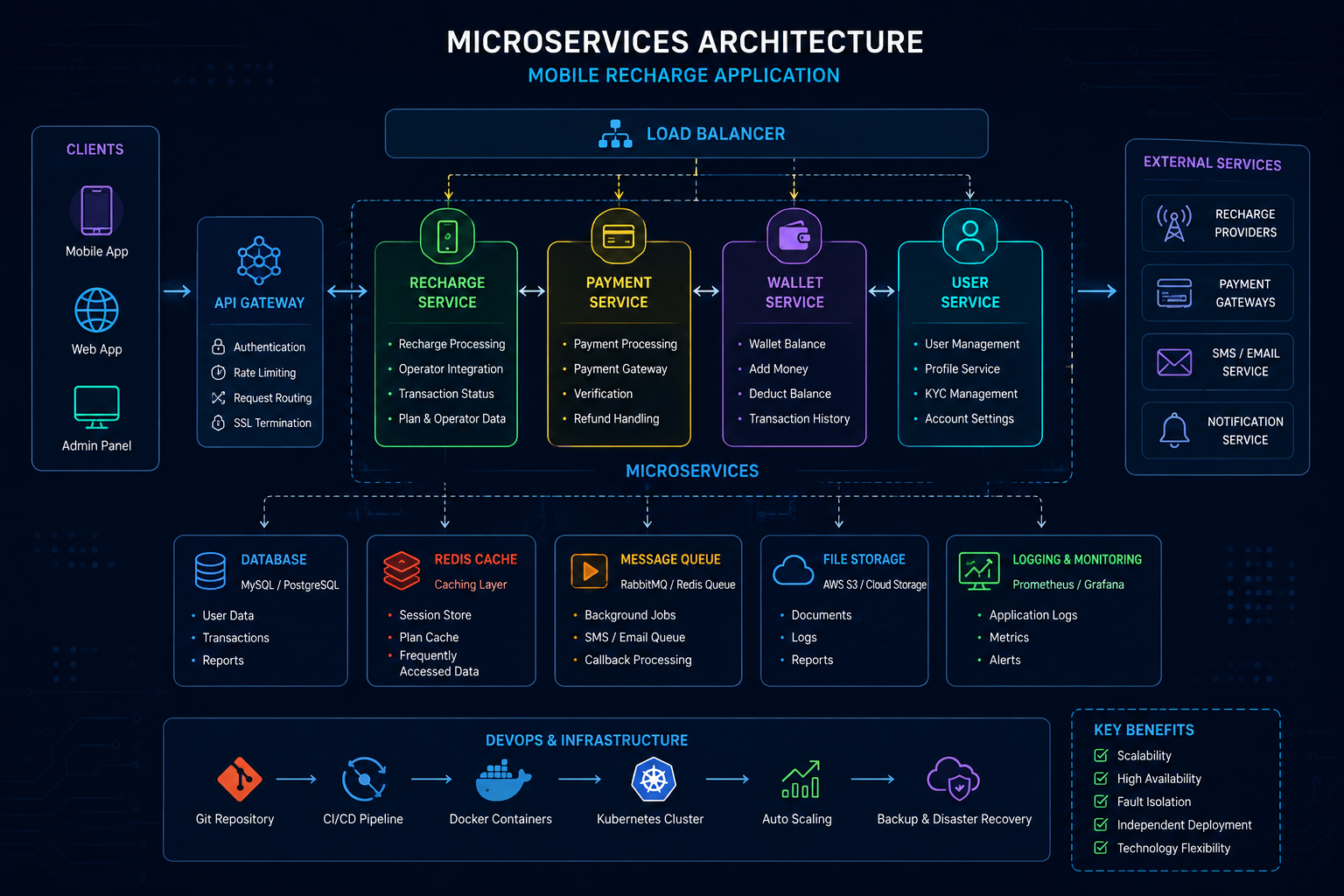
Most modern recharge platforms actually use a microservices architecture rather than one big monolith app. Something like:
- Recharge Service (talks to telecom APIs)
- Payment Service (talks to payment gateway)
- Wallet Service (manages balance, cashback)
- Notification Service (SMS, push, email)
- User Service (auth, KYC, profile)
Breaking things into services means if the "Notification Service" slows down during high load, it doesn't take down the "Payment Service" with it. This isolation is what actually keeps a recharge app alive during traffic spikes.
3. Message Queues: The Unsung Hero
This part is often skipped by beginner developers, and it's usually the reason apps crash during peak load.
When 10,000 users hit "recharge" at once, you cannot process all of them instantly and directly. Instead you push each request into a queue, and workers process them one by one (or in controlled batches) in the background. This prevents your database and telecom API from getting overwhelmed.
Recommended tools:
- Apache Kafka — industry standard for high-throughput event streaming, used by most large-scale fintech apps
- RabbitMQ — simpler to set up, great for mid-size recharge apps that don't need Kafka-level scale yet
- Redis Queue (BullMQ for Node.js) — lightweight option for startups just getting started
At HNB IT Solutions, we usually recommend RabbitMQ for apps expecting moderate scale, and Kafka once you're operating at a genuinely large user base (think lakhs of daily transactions).
4. Database: Where Accuracy Cannot Be Compromised
For a recharge app, your database has two very different jobs:
- Store transactional data (money movement) — needs to be 100% accurate, zero tolerance for errors
- Store user activity, logs, offers, history — needs to be fast to read, less critical if occasionally delayed
That's why most recharge apps use two types of databases together:
- PostgreSQL / MySQL — for transactional data (wallet balance, recharge records, payment logs). Relational databases with ACID compliance are non-negotiable here because you simply cannot risk double-deduction or lost transactions.
- MongoDB / Redis — for non-critical, fast-access data like recent searches, cached operator plans, session data, and offer banners
Redis specifically deserves a special mention — its used as an in-memory cache to store frequently accessed data (like current operator plan lists) so the app doesn't hit the main database every single time, which massively reduces load during high traffic.
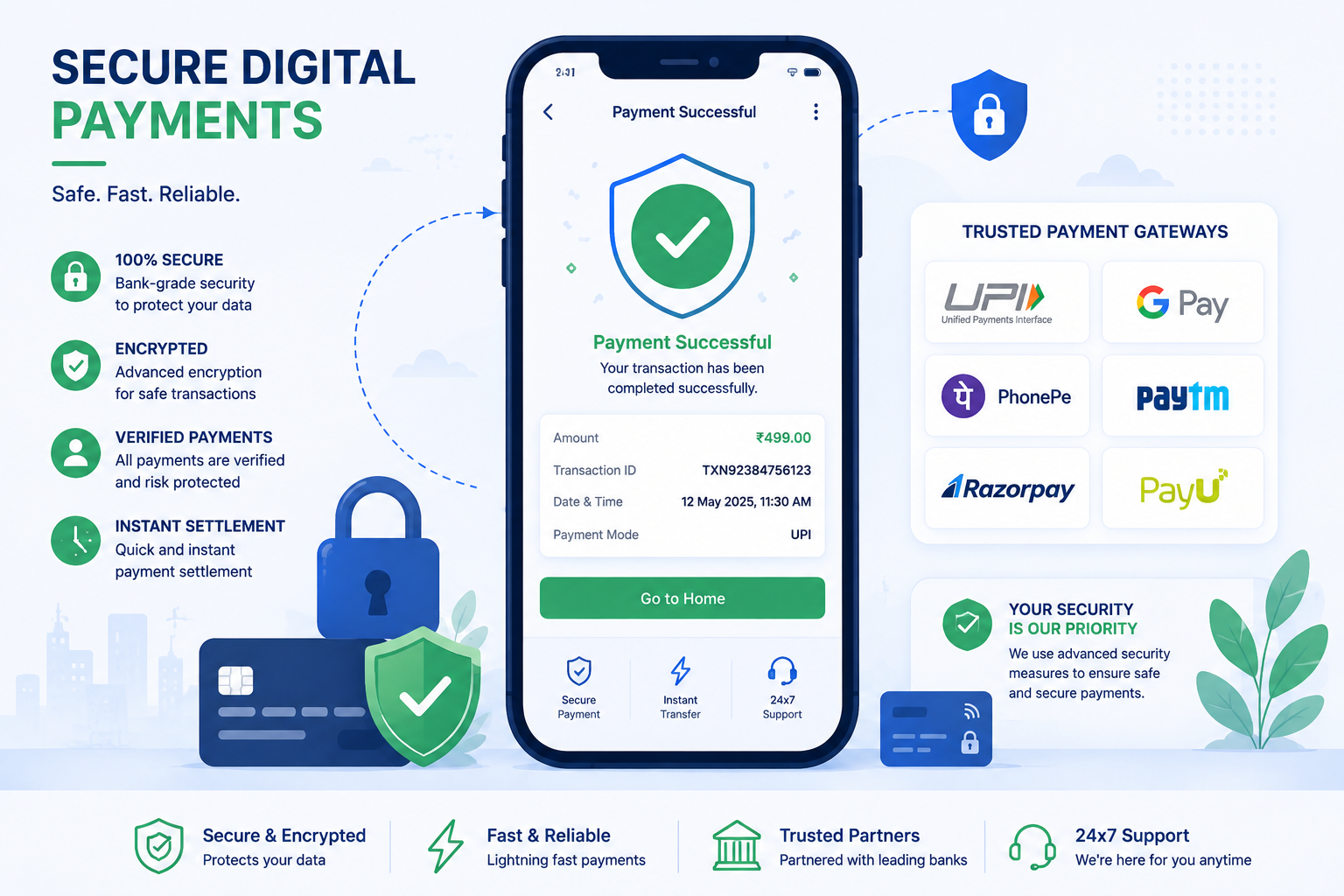
5. Payment Gateway Integration: The Most Sensitive Piece
This is genuinely the heart of any recharge app. A single second of delay or one failed callback here directly means lost money or a frustrated user.
What to look for in a payment stack:
- Multiple gateway support (Razorpay, PayU, Cashfree, etc.) so if one gateway is down, the app can auto-switch to a backup
- Webhook-based confirmation (never rely purely on the app's response — always confirm via server-to-server webhook)
- Idempotency keys — meaning even if a request is sent twice by mistake, the system recognizes it and doesn't charge twice
We at HNB IT Solutions always build a "payment reconciliation" module separately — a background service that double checks every transaction against the gateway's records every few minutes, just to catch any mismatched or stuck transactions before the user even notices.
6. Telecom API Integration (The Tricky Part)
Recharge apps depend on third-party telecom aggregator APIs (like a distributor API) that actually process the recharge on the operator's end. These APIs can be slow, occasionally unreliable, and sometimes give delayed responses.
To manage this properly:
- Always use asynchronous calls, never make the user wait on a blocking request
- Build a retry mechanism with exponential backoff for failed API calls
- Maintain a status polling system so if a recharge is "processing," the app checks back automatically instead of leaving the user hanging
This single piece — handling telecom API unpredictability — is honestly where most recharge app projects fail if not planned properly from day one.
7. Hosting & Infrastructure
For an app expecting high concurrency, shared hosting or a single server setup simply won't cut it.
Recommended infrastructure:
- AWS / Google Cloud / Azure — for auto-scaling servers based on real time traffic
- Kubernetes / Docker — for containerized microservices, making scaling individual services easier
- Load Balancers (like AWS ELB or Nginx) — to distribute incoming traffic evenly across multiple servers
- CDN (Cloudflare) — for faster static asset delivery, especially for the web/admin panel
Auto-scaling is the real MVP here — your infrastructure should automatically spin up extra servers when traffic increases (like during a festival sale) and scale back down when traffic normalizes, so your saving cost during low traffic and staying stable during high traffic.
8. Monitoring & Logging
You genuinely cannot manage what you can't measure. High-concurrency systems need real-time visibility.
Recommended tools:
- Grafana + Prometheus — for real-time server and application metrics
- ELK Stack (Elasticsearch, Logstash, Kibana) — for centralized logging across microservices
- Sentry — for catching and alerting on application errors instantly
Without proper monitoring, teams usually find out about an outage from angry user reviews instead of their own dashboard, which is obviously not where you want to be.
Putting It All Together: A Sample Blueprint
Here's what a realistic, production-ready stack might look like for a mid-to-large scale recharge app:
| Layer | Recommended Tech |
|---|---|
| Frontend (Mobile) | Flutter |
| Frontend (Admin Web) | React.js / Next.js |
| Backend | Node.js (NestJS) + Golang for critical services |
| Database (Transactional) | PostgreSQL |
| Database (Cache/Fast) | Redis, MongoDB |
| Message Queue | RabbitMQ / Kafka |
| Payment Gateway | Razorpay + PayU (multi-gateway) |
| Hosting | AWS with Kubernetes |
| Monitoring | Grafana, Sentry |
Final Thoughts
Building a mobile recharge app is not just a "development project," its a small-scale financial infrastructure that needs to behave perfectly under pressure. The right tech stack isn't about picking the trendiest tools, its about picking tools that don't break when real users, real money, and real traffic spikes collide all at once.
At HNB IT Solutions, being a leading AI, mobile app, and web development company based in Delhi, we've built our app development process specifically around this kind of reliability-first thinking. Whether its recharge apps, payment gateway integrations, or full-scale fintech platforms, we make sure the tech stack is chosen to match your actual scale, not just todays needs but tomorrows growth too.
If you're planning a mobile recharge app and want a tech stack that actually holds up under real-world traffic, our team at HNB IT Solutions would be happy to walk you through a custom architecture blueprint for your specific project.