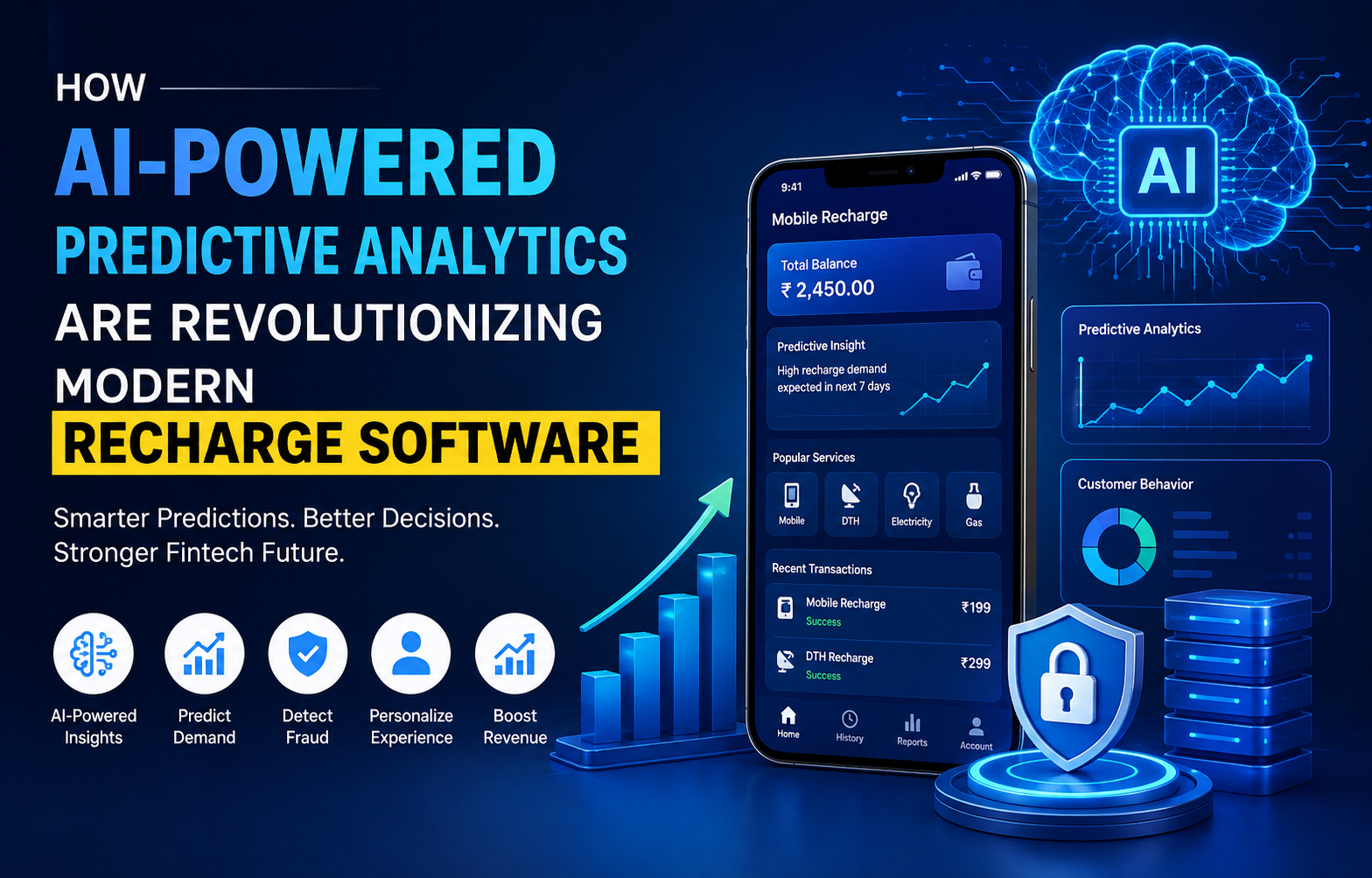
How AI-Powered Predictive Analytics Are Revolutionizing Modern Recharge Software
HNB IT Solutions Team
Aug 07, 2026
How AI-Powered Predictive Analytics Are Revolutionizing Modern Recharge Software
The fintech industry is changing faster than ever. Customers now expect payments, mobile recharges, bill payments, and other digital services to be quick, secure, and available almost instantly.
But behind a simple recharge button, there is a lot happening.
Modern recharge platforms need to process transactions, understand customer behaviour, identify unusual activity, reduce failed payments, manage large amounts of data, and provide businesses with useful insights.
This is where AI-powered predictive analytics comes into the picture.
By combining Artificial Intelligence (AI), machine learning, and large-scale data analysis, modern recharge software can do much more than simply process a transaction. It can analyse historical data, identify patterns, predict future customer behaviour, and help businesses make smarter decisions.
For fintech companies and businesses building digital payment platforms, predictive analytics is becoming an important part of modern software development.
What Is AI-Powered Predictive Analytics?
AI-powered predictive analytics is the process of using artificial intelligence and historical data to identify patterns and predict what could happen in the future.
For example, a recharge platform may analyse:
Previous recharge transactions
Recharge frequency
Customer preferences
Transaction amounts
Failed payment patterns
Device information
Time and location patterns
Payment methods
Customer engagement
Account activity
Instead of only showing what happened in the past, an AI-powered system can use this information to identify potential future trends.
For example, if a customer usually performs a mobile recharge every 28–30 days, the software can identify this behaviour and potentially provide a reminder or personalized offer around the expected recharge period.
This makes the software more intelligent and customer-focused.
Why Predictive Analytics Matters for Recharge Software
Traditional recharge software mainly focuses on transaction processing.
A modern AI-powered recharge platform can go much further.
It can help businesses understand why customers are performing certain transactions, when they are likely to recharge again, which services are becoming popular, and where transaction problems may occur.
This creates a major difference between a basic recharge system and an intelligent fintech platform.
Predictive analytics can help recharge businesses with:
Better customer understanding
Improved transaction monitoring
Personalized experiences
Fraud risk identification
Revenue forecasting
Customer retention
Payment optimization
Business decision-making
In simple words, AI turns raw transaction data into useful business intelligence.
1. Understanding Customer Recharge Behaviour
One of the biggest advantages of AI-powered predictive analytics is customer behaviour analysis.
A recharge platform can collect large amounts of transaction data. Manually analysing this information can be difficult, especially when the platform has thousands or millions of users.
AI can identify patterns automatically.
For example, it may discover that:
Some customers recharge at the beginning of every month.
Certain users prefer specific recharge plans.
Some customers frequently switch between plans.
Certain offers perform better with specific customer groups.
Recharge activity increases during particular periods.
These insights can help businesses create better customer experiences.
Instead of sending the same offer to everyone, businesses can potentially provide more relevant recommendations based on customer behaviour.
2. Predicting Future Recharge Demand
Another important application of predictive analytics is demand forecasting.
Recharge businesses need to understand how much transaction activity they may receive in the future.
AI models can analyse previous transaction volumes and identify trends.
For example, the system might identify increased recharge activity during:
Festivals
Holidays
Weekends
Special promotions
Seasonal periods
Major sporting events
Salary periods
This information can help businesses prepare their infrastructure and resources accordingly.
A growing recharge platform can therefore use predictive analytics to make better operational decisions instead of simply reacting after a traffic spike occurs.
3. Detecting Suspicious Transactions
Security is extremely important in fintech software.
Recharge platforms process financial transactions, which makes them a potential target for fraudulent or suspicious activities.
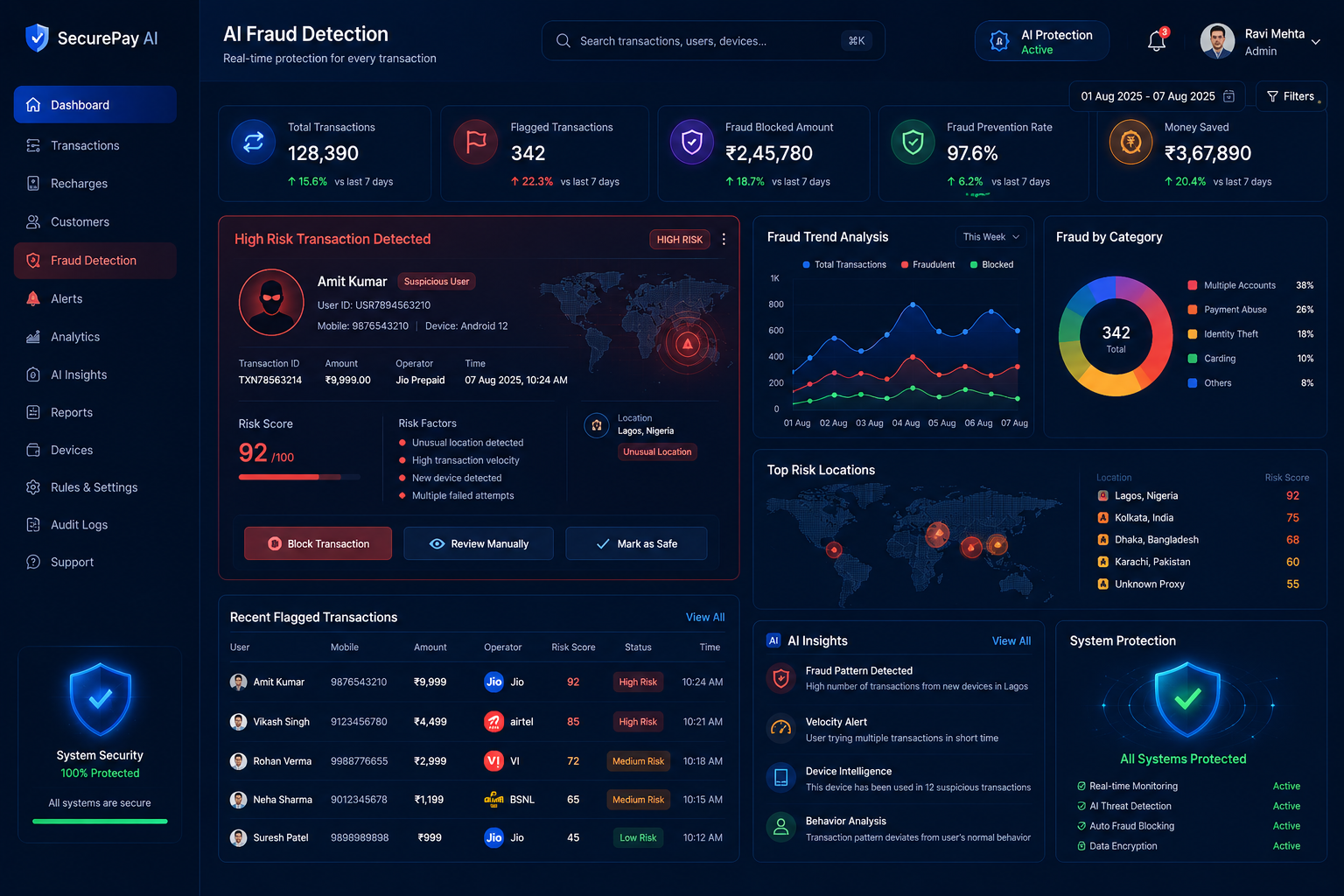
AI-powered predictive analytics can analyse transaction patterns and identify behaviour that looks unusual.
For example, a system could detect:
Unusual transaction frequency
Sudden changes in transaction values
Multiple transactions from unusual patterns
Abnormal account behaviour
Repeated failed transactions
Unexpected changes in user activity
The important point is that AI does not simply look at one transaction.
It can analyse patterns across multiple transactions and compare them with historical behaviour.
This can help fintech platforms build stronger monitoring systems.
AI-based fraud detection should work alongside appropriate security controls, transaction rules, authentication, and regulatory requirements rather than replacing them completely.
4. Reducing Failed Recharge Transactions
Failed transactions are frustrating for customers and can also affect business revenue.
Predictive analytics can help identify patterns behind failed transactions.
For example, AI can analyse whether failures are more common with:
Particular payment methods
Specific transaction amounts
Certain time periods
Particular service providers
Specific technical conditions
Repeated customer attempts
Once these patterns are identified, developers and businesses can investigate the underlying causes.
This can help improve the overall reliability of a recharge platform.
The goal is not simply to process more transactions but to create a smoother and more reliable payment experience.
5. Personalized Recharge Recommendations
Personalization has become an important part of digital platforms.
Customers don't always want to search through hundreds of options.
An AI-powered recharge platform can analyse previous activity and potentially recommend relevant plans or services.
For example:
Customer A frequently chooses a particular recharge range.
The platform can highlight similar options.
Customer B regularly uses a specific service.
The platform can prioritize relevant recharge options.
This type of personalization can make the user interface simpler and potentially improve customer engagement.
6. AI-Powered Revenue Forecasting
Predictive analytics can also help businesses understand potential future revenue.
By analysing historical transaction data, customer activity, seasonal trends, and other relevant metrics, AI systems can generate forecasts.
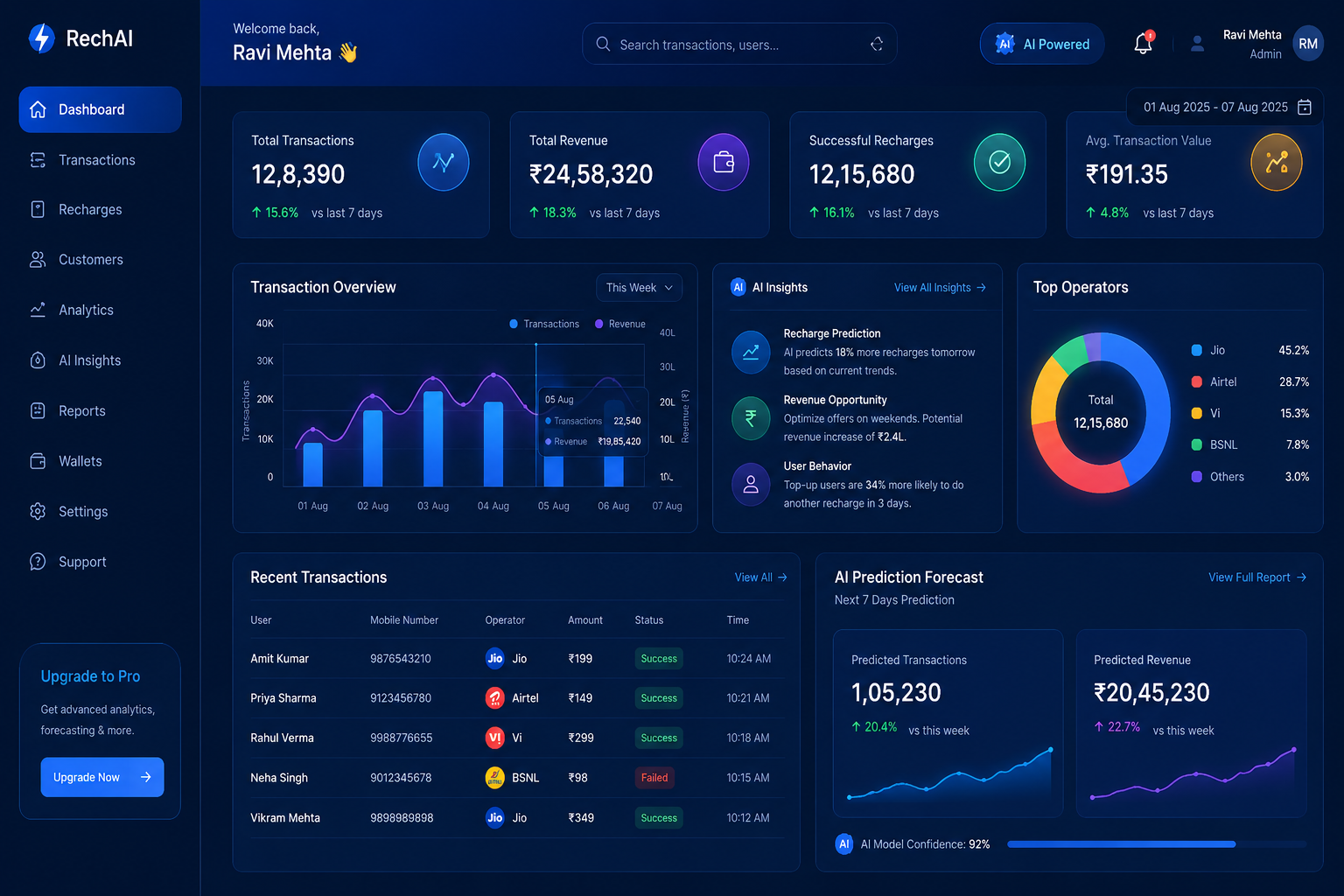
For example, a business dashboard could provide insights such as:
Expected transaction volume
Estimated recharge demand
Customer activity trends
Revenue growth patterns
Popular recharge categories
Customer retention trends
These insights can help management teams make better decisions.
Instead of depending only on spreadsheets and manually prepared reports, businesses can use automated analytics dashboards to monitor important metrics.
7. Better Business Intelligence for Fintech Companies
Data is one of the most valuable resources for modern fintech businesses.
However, having data and understanding data are two different things.
A recharge platform may generate thousands of transactions every day, but raw transaction records don't automatically provide meaningful insights.
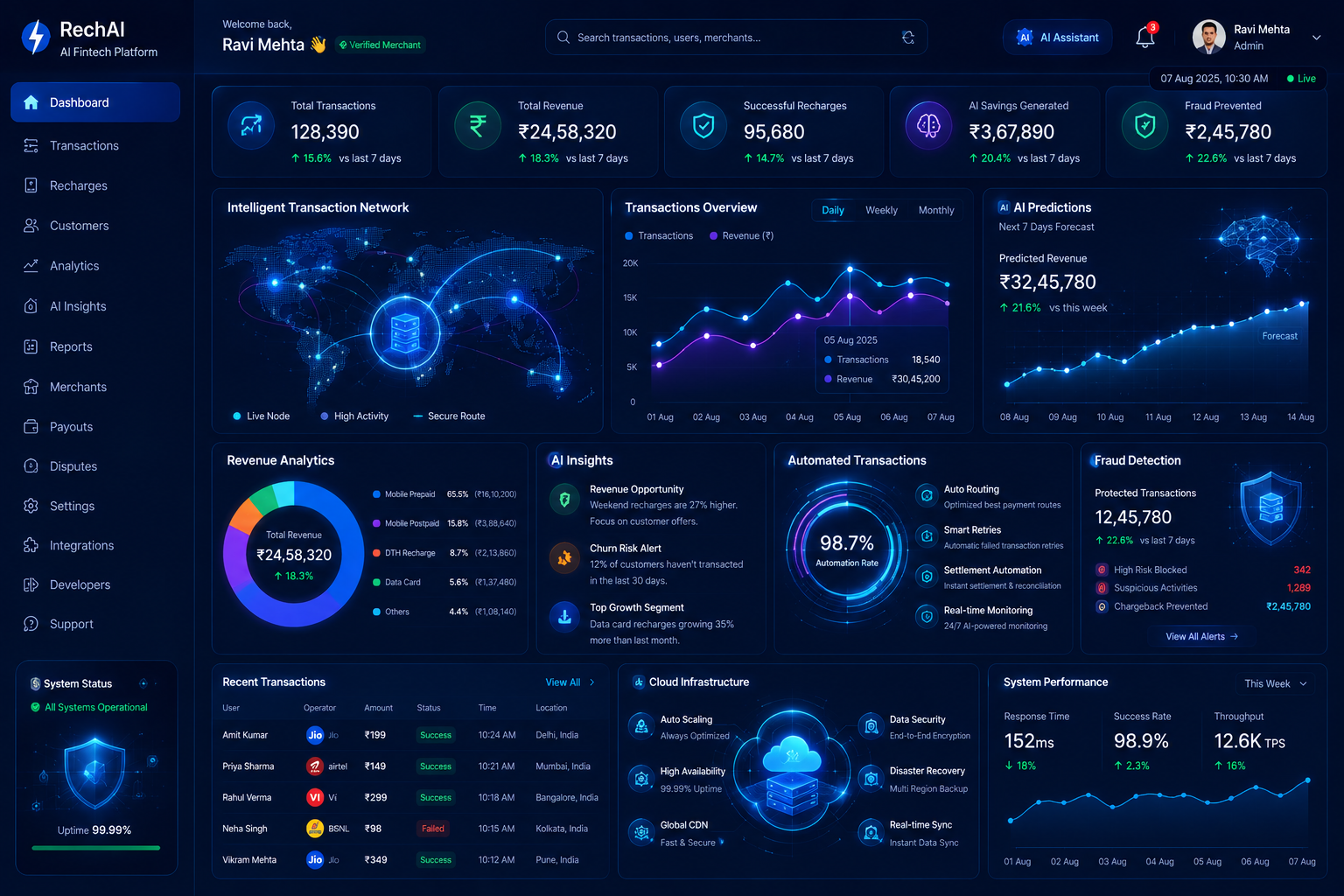
AI-powered analytics can convert this raw information into dashboards and reports that are easier to understand.
For example:
Raw Data → AI Analysis → Pattern Detection → Prediction → Business Decision
This is where predictive analytics becomes especially useful.
8. Improving Customer Retention
Getting a new customer is only one part of building a successful digital platform.
Keeping existing customers is equally important.
Predictive analytics can help identify behavioural patterns that may indicate reduced customer engagement.
For example, if a customer who normally recharges frequently suddenly becomes inactive, the system may identify this change.
Businesses can then use appropriate customer engagement strategies such as:
Relevant notifications
Personalized offers
Recharge reminders
Loyalty programs
Service recommendations
This can help businesses create a more proactive customer experience.
9. AI and Automated Recharge Notifications
Recharge reminders are another practical use case.
Instead of sending generic notifications at random times, AI can analyse historical behaviour and estimate when a customer may need to recharge again.
For example:
Previous activity: Recharge approximately every 30 days.
AI prediction: Customer may be approaching the next recharge period.
Action: Send a useful reminder.
This can make notifications more relevant and less annoying.
Of course, businesses should also follow applicable privacy, consent, and communication regulations when using customer data.
10. AI-Powered Recharge Software and Scalability
As a recharge platform grows, the amount of data it generates also increases.
A small platform might process hundreds of transactions.
A large fintech platform could process thousands or millions.
Traditional reporting systems may struggle to provide real-time insights at this scale.
Modern cloud infrastructure, scalable databases, APIs, machine learning systems, and analytics engines can help businesses build platforms capable of handling larger workloads.
This is why AI should not be treated as just another feature.
It should be considered as part of the overall software architecture.
What Features Should Modern AI Recharge Software Include?
Businesses planning to develop an AI-powered recharge platform can consider several important features.
Core Recharge Features
Mobile recharge
DTH recharge
Utility bill payments
Multiple service providers
Recharge history
Transaction tracking
Automated receipts
Wallet or account management
AI & Analytics Features
Customer behaviour analytics
Predictive recharge analysis
Demand forecasting
Transaction pattern analysis
Revenue forecasting
Personalized recommendations
Fraud risk monitoring
Automated business reports
Admin Panel Features
User management
Transaction management
API management
Service provider management
Commission management
Reports and analytics
Notifications
Role-based access
Security Features
Secure authentication
API security
Encryption
Access controls
Transaction monitoring
Activity logs
Secure payment integration
The exact feature set depends on the business model, target market, integrations, and regulatory requirements.
The Role of APIs in Modern Recharge Software
APIs are the backbone of many modern recharge platforms.
A recharge application may need to communicate with multiple external systems, including:
Recharge APIs
Payment services
SMS providers
Notification systems
Identity services
Analytics platforms
Business intelligence systems
A well-designed API architecture makes it easier to connect these services.
For an AI-powered platform, APIs can also be used to send relevant transaction and behavioural data to analytics or machine-learning systems.
This creates an ecosystem where different components work together rather than operating as separate systems.
AI-Powered Predictive Analytics vs Traditional Recharge Software
Feature
Traditional Recharge Software
AI-Powered Recharge Software
Transaction Processing
Yes
Yes
Basic Reports
Yes
Yes
Customer Behaviour Analysis
Limited
Advanced
Demand Forecasting
Limited
AI-assisted
Personalization
Basic
Advanced
Fraud Pattern Detection
Rule-based
AI + rules
Revenue Forecasting
Manual
Predictive
Automated Insights
Limited
Advanced
Customer Segmentation
Basic
AI-assisted
Decision Support
Limited
Data-driven
The biggest difference is that traditional software primarily tells businesses what happened, while predictive analytics can help them understand what may happen next.
Challenges of Implementing AI in Recharge Software
AI provides significant opportunities, but implementation should be planned carefully.
Data Quality
AI models are only as useful as the data they receive.
Incorrect, incomplete, or poorly structured data can affect prediction quality.
Data Privacy
Fintech platforms handle sensitive information. Businesses need proper data protection, access control, security practices, and compliance processes.
Integration Complexity
Connecting AI systems with existing recharge APIs, payment systems, databases, and admin panels can require careful technical planning.
Infrastructure
Large-scale predictive analytics may require scalable cloud infrastructure and appropriate data processing architecture.
Model Monitoring
AI models should be monitored and updated as customer behaviour and business conditions change.
Future of AI-Powered Recharge Software
The future of recharge software is likely to become increasingly intelligent.
Instead of simply providing a transaction interface, future platforms can become complete decision-support systems for fintech businesses.
We can expect greater use of:
Real-time transaction analytics
AI-powered customer segmentation
Predictive fraud detection
Automated business forecasting
Intelligent recommendations
Conversational AI support
Automated financial reporting
Real-time anomaly detection
AI-based operational optimization
The combination of AI + predictive analytics + fintech + automation can create a much more powerful software ecosystem.
Final Thoughts
AI-powered predictive analytics are changing the way modern recharge software is designed and operated.
A recharge platform is no longer limited to processing transactions. With the right technology, it can analyse customer behaviour, identify patterns, forecast demand, monitor suspicious activity, improve personalization, and provide valuable business insights.
For fintech businesses, this means better visibility and smarter decision-making.
However, successful implementation requires more than simply adding an AI feature. Businesses need a secure architecture, reliable APIs, quality data, scalable infrastructure, strong security practices, and a clear understanding of their business requirements.
At HNB IT Solutions, we help businesses build modern software solutions including AI tools, mobile applications, web applications, fintech software, payment integrations, digital marketing solutions, and custom software platforms.
If you are planning to build an AI-powered recharge platform or a custom fintech application, the right technology architecture can make a major difference in scalability, security, and future growth.
Build smarter. Analyse better. Scale faster with AI-powered software.
Frequently Asked Questions (FAQs)
1. What is AI-powered predictive analytics in recharge software?
AI-powered predictive analytics uses Artificial Intelligence and historical transaction data to identify patterns and predict future customer behaviour, recharge demand, transaction trends, and potential risks. It helps modern recharge software become more intelligent and data-driven.
2. How can AI improve recharge software?
AI can improve recharge software by helping businesses understand customer behaviour, predict recharge demand, personalize recommendations, identify unusual transaction patterns, reduce failed transactions, and generate automated business insights.
3. What is predictive analytics in fintech?
Predictive analytics in fintech uses historical and real-time data, statistical models, and AI technologies to forecast future trends and behaviours. It can be used for customer analytics, fraud monitoring, revenue forecasting, transaction analysis, and financial decision-making.
4. Can AI help detect fraud in recharge software?
Yes. AI can analyse transaction patterns and identify unusual activities that may indicate suspicious behaviour. However, AI-based detection should be combined with authentication, security controls, transaction rules, monitoring systems, and applicable regulatory requirements.
5. Can AI predict when a customer will recharge again?
AI can analyse previous recharge frequency and customer behaviour to estimate when a customer may be likely to recharge again. Businesses can potentially use these insights for relevant reminders and personalized engagement.
6. How does predictive analytics help increase customer retention?
Predictive analytics can identify changes in customer behaviour, such as reduced activity or changes in recharge frequency. Businesses can use these insights to create more relevant offers, reminders, loyalty programs, and customer engagement strategies.
7. What features should an AI-powered recharge platform have?
Important features can include recharge and bill payment services, payment integration, transaction management, customer analytics, predictive analytics, fraud monitoring, personalized recommendations, reporting dashboards, API integrations, notifications, and a secure admin panel.
8. Is AI-powered recharge software suitable for fintech startups?
Yes. AI-powered recharge software can be useful for fintech startups that want to build scalable platforms with customer analytics, automation, intelligent reporting, and predictive capabilities. The technology architecture should be selected according to the startup's expected transaction volume and business requirements.
9. How much does it cost to develop AI-powered recharge software?
The cost depends on factors such as the number of features, UI/UX requirements, AI functionality, third-party API integrations, admin panel, security requirements, cloud infrastructure, and platform support. A basic recharge application will generally require less development effort than a fully customized AI-powered fintech platform.
10. Can AI recharge software integrate with payment APIs?
Yes. A properly designed recharge platform can integrate with relevant payment APIs, recharge APIs, SMS services, notification systems, analytics tools, and other third-party services through secure API architecture.
11. Is AI recharge software secure?
AI itself does not automatically make software secure. A secure recharge platform should use appropriate authentication, encryption, API security, access controls, activity monitoring, secure infrastructure, and other security practices. Regular security testing and compliance reviews are also important.
12. Why should businesses choose custom recharge software development?
Custom software allows businesses to build features according to their specific requirements instead of relying entirely on a generic platform. It can also provide greater flexibility for integrations, branding, analytics, automation, scalability, and future AI functionality.
13. Who can develop AI-powered recharge software?
A professional software development company with experience in AI, fintech, APIs, mobile applications, web applications, and secure payment integrations can help businesses plan and develop an AI-powered recharge platform.
14. What is the future of AI-powered recharge software?
The future is likely to include more real-time analytics, AI-powered customer segmentation, predictive fraud monitoring, automated forecasting, intelligent recommendations, conversational AI, and automated business intelligence.
15. Can HNB IT Solutions develop custom AI-powered fintech software?
Yes. HNB IT Solutions provides custom software development services including AI tools, mobile app development, web applications, fintech-related solutions, API integrations, payment integrations, and digital solutions for businesses.