Digital Marketing for AI Products – Complete Strategy for 2026
Artificial Intelligence is changing the way businesses work, communicate, and serve their customers. From AI-powered chatbots and automation software to image generators, content writing tools, and intelligent business applications, AI products are becoming an important part of the digital world.
However, building a great AI product is only one part of running a successful business. The bigger challenge is getting people to discover your product, understand its benefits, trust its capabilities, and eventually become paying customers.
This is where digital marketing for AI products becomes important.
In 2026, marketing an AI product requires more than just running advertisements or publishing a few social media posts. Businesses need a complete strategy that combines Search Engine Optimization (SEO), content marketing, social media marketing, paid advertising, email campaigns, influencer collaborations, and conversion optimization.
Whether you are launching a new AI startup, developing an AI SaaS platform, or selling AI-powered software, the right marketing strategy can help you reach your target audience and build a strong online presence.
In this guide, we will explore how to market AI products in 2026, which digital marketing channels work best, and how businesses can generate quality leads and grow their customer base.
What Is Digital Marketing for AI Products?
Digital marketing for AI products refers to promoting artificial intelligence-based software, applications, platforms, and tools through online marketing channels.
The main objective is to connect an AI product with people who can benefit from its features.
For example, imagine you have developed an AI tool that automatically creates social media posts for businesses. Your potential customers could include:
- Digital marketing agencies
- Small business owners
- Social media managers
- Content creators
- Marketing professionals
- Startup founders
Instead of promoting your product to everyone, you need to reach people who actually need your solution.
A successful AI product marketing strategy focuses on three important things:
Awareness: Helping potential customers discover your AI product.
Trust: Explaining how your product works and why people should use it.
Conversions: Encouraging interested users to sign up, purchase a subscription, or request a demo.
The more clearly you communicate your product's value, the easier it becomes to attract the right audience.
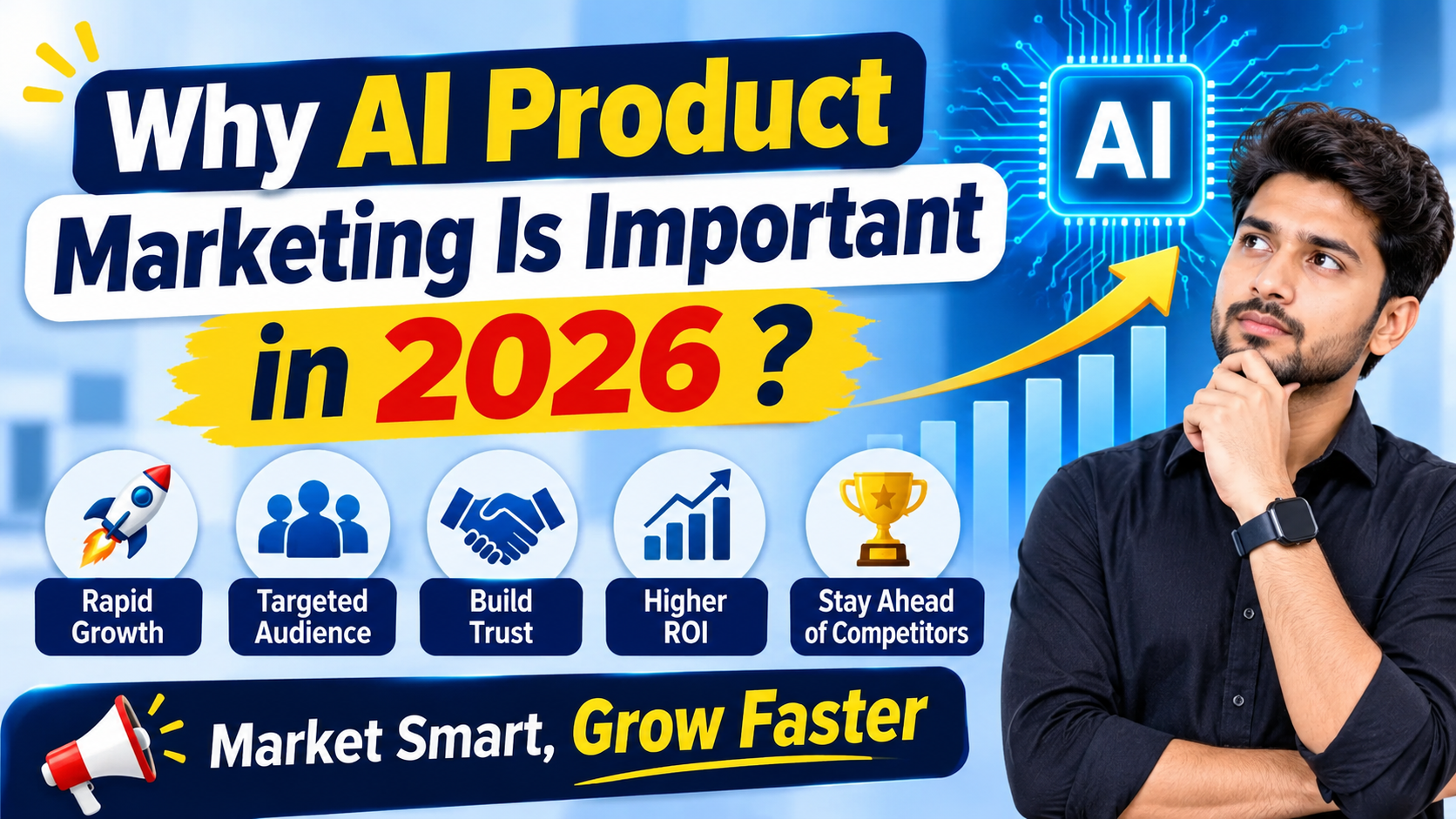
Why AI Product Marketing Is Important in 2026
The AI software market is becoming increasingly competitive. New tools and platforms are launching regularly, giving customers more choices than ever before.
Even if your AI product offers excellent features, people may never discover it without proper marketing.
Here are some reasons why digital marketing is important for AI businesses.
1. Build Brand Awareness
When people search for AI tools, they usually find multiple websites offering similar solutions.
A strong digital marketing strategy helps your brand become visible through Google search results, social media platforms, YouTube, and other online channels.
2. Reach the Right Audience
Not every person needs the same AI solution.
For example, an AI video editing tool may be useful for content creators, while an AI inventory management platform may be more suitable for retailers.
Targeted marketing helps you connect with the audience most likely to purchase your product.
3. Generate Quality Leads
Digital marketing allows AI businesses to attract potential customers through website forms, free trials, product demonstrations, newsletters, and consultation requests.
These leads can later be converted into paying customers.
4. Build Customer Trust
People want to understand how an AI product works before investing their money.
Product demonstrations, customer testimonials, case studies, tutorials, and transparent pricing can help build confidence.
5. Increase Long-Term Business Growth
SEO, content marketing, email marketing, and customer retention campaigns can create long-term opportunities for business growth.
Instead of depending entirely on paid advertisements, businesses can develop multiple sources of website traffic and leads.
Complete Digital Marketing Strategy for AI Products in 2026
A successful AI product marketing campaign should combine different digital channels rather than depending on just one marketing method.
Let's understand the most important strategies.
1. Search Engine Optimization (SEO) for AI Products
SEO is one of the most valuable long-term marketing strategies for AI software companies.
When someone searches for terms such as "best AI writing tool," "AI chatbot for business," or "AI automation software," they are already looking for a solution.
If your website appears for relevant search queries, you can attract visitors who are genuinely interested in your product.
Here are some important SEO activities for AI businesses.
Keyword Research
Start by identifying the search terms your potential customers use.
Some examples include:
- Best AI tools for business
- AI software development company
- AI automation tools
- AI chatbot software
- AI content generation tools
- AI tools for small businesses
- Custom AI application development
Choose keywords based on search intent, competition, and relevance to your product.
Create Helpful Blog Content
Publish informative articles that answer real customer questions.
For example:
- How AI Tools Can Improve Business Productivity
- Best AI Automation Tools for Small Businesses
- How to Choose the Right AI Software
- Benefits of AI Chatbots for Customer Support
- AI-Powered Business Applications: Features and Benefits
Avoid publishing articles only to insert keywords. Each article should solve a specific problem or explain something useful.
Optimize Product Pages
Every AI product should have a dedicated website page explaining its features, benefits, use cases, pricing, and frequently asked questions.
Add clear headings, descriptive page titles, internal links, and relevant images.
Technical SEO
Make sure your website loads quickly, works properly on mobile devices, has a clear website structure, and can be crawled and indexed by search engines.
SEO also matters in the age of AI-powered search. Creating helpful, original, well-structured content remains important for visibility in Google's AI search experiences.
2. Content Marketing for AI Products
Content marketing helps potential customers understand your product before they decide to purchase it.
AI products can sometimes be difficult to explain, especially when they involve automation, machine learning, integrations, or advanced technical features.
Instead of using complicated technical language, explain how your product solves everyday problems.
Some effective content marketing ideas include:
Step-by-step product tutorials
- AI tool comparison articles
- Feature explanation videos
- Industry-specific use cases
- Customer success stories
- Product launch announcements
- Educational blog posts
- Free AI resources and guides
For example, if you have developed an AI customer support platform, publish an article explaining how businesses can automate customer queries and reduce repetitive manual work.
This type of content attracts people who are already interested in the problem your product solves.
3. Social Media Marketing for AI Businesses
Social media is an excellent channel for introducing AI products to new audiences.
Platforms such as LinkedIn, Instagram, Facebook, and YouTube offer different opportunities depending on your target customers.
LinkedIn Marketing
LinkedIn is particularly useful for B2B AI products, enterprise software, SaaS platforms, and business automation solutions.
Share:
- Product updates
- Industry insights
- Business use cases
- Case studies
- AI technology trends
- Company announcements
Instagram Marketing
Instagram works well for short product demonstrations, feature highlights, reels, educational content, and visual storytelling.
Create short videos showing how your AI tool works instead of only posting promotional graphics.
YouTube Marketing
YouTube is useful for detailed product tutorials, walkthroughs, comparisons, and demonstrations.
A video showing an AI product solving a real business problem can be more convincing than a simple advertisement.
Facebook Marketing
Facebook can help businesses reach specific communities, run targeted campaigns, promote product demonstrations, and build remarketing audiences.
The important thing is to select platforms based on where your potential customers spend their time.
4. Paid Advertising for AI Products
Paid advertising can help AI businesses generate traffic and leads more quickly.
However, advertising without a clear target audience or landing page can waste your marketing budget.
The most useful advertising channels include:
Google Ads
Google Ads can help you reach people actively searching for AI software and related services.
For example, you can target search terms related to AI automation software, AI chatbot development, or AI productivity tools.
Meta Ads
Facebook and Instagram advertisements can help introduce your AI product to relevant audiences.
Use short videos, product screenshots, feature demonstrations, and clear calls to action.
LinkedIn Ads
For enterprise AI solutions and B2B software, LinkedIn advertising can help target professionals, business owners, decision-makers, and specific industries.

Tips for Better AI Product Advertising
Use a clear and benefit-focused headline.
- Show the actual product interface.
- Explain the problem your tool solves.
- Create separate campaigns for different audiences.
- Send visitors to dedicated landing pages.
- Track leads, registrations, and actual sales.
- Test different creatives and advertising messages.
Remember, getting clicks is not the final objective. The real goal is acquiring customers who find value in your AI product.
5. Create a High-Converting Website and Landing Page
Your website is often the first place where potential customers learn about your AI product.
A professional website can make a significant difference in how people perceive your brand.
Your website should clearly explain what your product does, who it is designed
for, and why customers should choose it.
Here are some essential website elements:
Clear Homepage Headline
Explain your product's main benefit in a simple sentence.
Product Features
Highlight the most useful features with screenshots, icons, and short explanations.
Product Demonstration
Add demo videos or interactive previews to help visitors understand how the software works.
Pricing Information
Present your pricing plans clearly wherever possible.
Customer Testimonials
Show genuine feedback and customer experiences to build trust.
Strong Call to Action
Use clear buttons such as:
Start Free Trial
Book a Demo
Get Started
Contact Our Team
SEO-Friendly Website Structure
Use descriptive URLs, relevant headings, optimized images, internal linking, and properly written metadata.
Your website should also be responsive, secure, and easy to navigate.
6. Email Marketing and Lead Nurturing
Not every person who visits your website will purchase your AI product immediately.
Some visitors may need more information, while others may want to compare different solutions before making a decision.
Email marketing helps you stay connected with these potential customers.
You can create automated email campaigns for:
New user registrations
- Free trial users
- Product updates
- Feature announcements
- Educational newsletters
- Special offers
- Customer onboarding
For example, when someone signs up for your AI tool, send a welcome email explaining how to use its main features.
A few days later, you can share a tutorial showing how to get better results from the product.
Keep emails useful and relevant rather than sending too many promotional messages.
7. Influencer Marketing and AI Product Reviews
People often trust product demonstrations and genuine experiences when evaluating new software.
Collaborating with relevant creators, technology reviewers, industry experts, and educational channels can help introduce your AI product to an established audience.
For example, if you have developed an AI video generation platform, collaborate with content creators who regularly review video editing and AI tools.
You can offer:
- Free product access
- Sponsored demonstrations
- Honest product reviews
- Tutorial collaborations
- Affiliate partnerships
Choose creators whose audience matches your ideal customer profile.
Focus on genuine product experiences rather than exaggerated promotional claims.
8. Product Demo Videos and Short-Form Content
One of the biggest challenges in AI product marketing is explaining what the software actually does.
A short demonstration can make this much easier.
Create videos showing:
- How to use the AI tool
- How the dashboard works
- What problems the software solves
- How automation saves time
- Important product features
- Before-and-after results
You can publish these videos on YouTube Shorts, Instagram Reels, Facebook, and LinkedIn.
Keep the opening few seconds interesting and demonstrate the actual product as early as possible.
9. App Store Optimization for AI Mobile Applications
If your AI product is available as a mobile application, App Store Optimization (ASO) should also be part of your marketing strategy.
ASO helps improve the discoverability of mobile applications in app marketplaces.
Important ASO activities include:
- Writing keyword-focused app titles
- Creating attractive app icons
- Adding clear app descriptions
- Uploading high-quality screenshots
- Creating app preview videos
- Encouraging genuine user reviews
- Regularly updating app features
A well-optimized application listing can help attract users who are searching for similar AI solutions.
10. Analytics, Tracking, and Marketing Automation
Marketing without measurement makes it difficult to understand what is working.
AI businesses should track important marketing metrics to improve their campaigns.
Some useful tools include:
- Google Analytics 4
- Google Search Console
- Google Tag Manager
- Meta Ads Manager
- Google Ads
- CRM and email marketing platforms
- Track metrics such as:
- Website visitors
- Organic search traffic
- Lead generation
- Conversion rate
- Cost per lead
- Customer acquisition cost
- Free trial registrations
- Paid subscriptions
- Customer retention
For example, if your website receives thousands of visitors but very few people request a demo, you may need to improve your landing page, product messaging, or call-to-action placement.
Data helps you make better marketing decisions.
11. AI Search Optimization: An Important Focus for 2026
The way people search for information is changing.
Apart from traditional search results, users are increasingly interacting with AI-powered search experiences to discover products, compare software, and find solutions.
This creates new opportunities for AI businesses.
To improve your visibility, focus on:
Answer Real Customer Questions
Create content that directly answers specific questions about your product and industry.
Publish Original Information
Share practical insights, original research, product comparisons, and real-world examples.
Build Topical Authority
Create connected articles covering different aspects of your product category.
Maintain Accurate Business Information
Keep your website, product details, contact information, and company profiles consistent.
Optimize for Traditional SEO
Make sure your content is crawlable, indexed, well-structured, and supported by useful internal links.
There is no guaranteed shortcut to appearing in AI-generated search answers. Focus on building a reliable online presence and publishing genuinely useful information.
12. Build a Complete Marketing Funnel for Your AI Product
A marketing funnel helps you guide potential customers from their first interaction with your brand to becoming paying users.
A simple AI product marketing funnel can include four stages.
Stage 1: Awareness
Introduce your product through SEO, social media, YouTube, influencer marketing, and advertisements.
Stage 2: Interest
Provide useful blog articles, product demonstrations, tutorials, and feature explanations.
Stage 3: Consideration
Offer free trials, product demos, comparison pages, case studies, and transparent pricing.
Stage 4: Conversion and Retention
Convert interested users into customers through follow-ups, onboarding, customer support, and product improvements.
The journey does not end after a customer makes a purchase. Retaining existing customers is also an important part of sustainable business growth.
13. Common Digital Marketing Mistakes AI Startups Should Avoid
Many AI startups have excellent products but struggle to attract customers because of avoidable marketing mistakes.
Here are some common problems to watch out for:
1. Targeting Everyone
Trying to sell your AI product to every type of customer makes your marketing message less effective. Identify your ideal audience first.
2. Focusing Only on Paid Ads
Paid advertising can generate traffic, but depending entirely on advertisements may become expensive. Build organic marketing channels too.
3. Ignoring SEO
Without proper SEO, your website may miss opportunities to attract people searching for your product category.
4. Using Too Much Technical Language
Most customers want to understand the benefits, not the complex technology behind every feature.
5. Not Showing the Actual Product
People are more likely to understand your solution when they can see a real demonstration.
6. Ignoring Customer Feedback
Customer questions and feedback can help you improve your product, website content, and marketing strategy.
7. Making Unrealistic Claims
Avoid promising guaranteed results, complete automation, or perfect accuracy unless you can genuinely support those claims.
14. A Practical 90-Day Digital Marketing Plan for AI Products
If you are launching an AI product in 2026, you can use the following roadmap to organize your marketing activities.
First 30 Days: Build Your Foundation
Identify your target audience.
Research relevant SEO keywords.
Create a professional website.
Optimize your product landing pages.
Set up Google Analytics and Search Console.
Create social media business profiles.
Prepare product demo videos.
Develop your initial content calendar.
Days 31–60: Start Marketing and Generate Leads
Publish helpful SEO blog articles.
Start Google Ads campaigns.
Test Meta advertising creatives.
Publish regular social media content.
Share product tutorials on YouTube.
Launch email marketing campaigns.
Connect with relevant influencers.
Collect customer questions and feedback.
Days 61–90: Analyze and Improve
Review website traffic and conversions.
Identify your best-performing keywords.
Optimize landing pages.
Improve advertisements based on performance.
Create more content around successful topics.
Start remarketing campaigns.
Improve your lead follow-up process.
Focus on customer retention.
This roadmap provides a starting point. The actual results will depend on your product, industry, budget, competition, and execution.
15. How HNB IT Solutions Can Help Your Business Grow Digitally
Developing an AI product is just the beginning. To turn your idea into a successful digital business, you also need the right technology, website infrastructure, and marketing strategy.
HNB IT Solutions is a software and app development company based in Delhi, India, helping businesses build and strengthen their digital presence.
We provide technology and digital solutions designed around different business requirements.
Our services include:
AI Tools Development
Custom AI-powered tools and business applications designed to improve workflows, productivity, and automation.
Mobile App Development
Android and iOS application development with modern UI/UX design and business-focused functionality.
Web App Development
Custom web applications and software solutions built around your business processes.
Payment Gateway Integration
Payment gateway integration services to help businesses accept and manage online transactions.
SMS & Bulk SMS Services
SMS integration and bulk messaging solutions for business notifications, customer communication, and updates.
Digital Marketing Services
SEO, social media marketing, online advertising, and digital brand promotion to help businesses reach their target audience.
Software Consultancy
Technical guidance to help businesses select the right technologies and plan their software development projects.
We also help businesses create SEO-friendly websites, configure domain names, and develop secure, scalable digital solutions.
Whether you are a startup planning to launch a new AI tool or an established company looking to upgrade your digital infrastructure, having the right development partner can make the process easier.
Visit our website to explore our services: https://hnbitsolutions.com/
Conclusion: Start Building a Strong Digital Presence for Your AI Product
Digital marketing for AI products in 2026 requires a combination of technology, creativity, customer understanding, and consistent execution.
From SEO and content marketing to paid advertisements, social media, email campaigns, and AI search optimization, every channel has a role in helping your product reach the right audience.
The most important thing is to focus on the value your AI product provides.
Understand your customers, explain your product clearly, publish useful content, demonstrate real features, and continuously improve your marketing campaigns using performance data.
You don't need to start every marketing activity at once. Begin with a strong website, build your SEO foundation, create helpful content, and gradually expand into paid advertising and other channels.
With the right strategy and consistent efforts, your AI product can build brand awareness, attract potential customers, and create long-term business opportunities.
Looking to develop an AI tool, mobile application, or custom web solution for your business?
Connect with HNB IT Solutions and take the next step towards building your digital presence.
Website: https://hnbitsolutions.com/